Füsun’s dinner invitation
The Museum of InnocenceFüsun’s dinner invitation is the brief letter that transforms Kemal’s uncertain hope of seeing her again into a specific invitation to supper with her parents. Sent after weeks without an answer to his own letter, it names May 19, 1976, as the evening they will receive him and gives him their address in Çukurcuma. Its restrained welcome and practical details contrast with the intensity of Kemal’s waiting: the letter does not promise the future he longs for, but it gives him a place and time at which to meet Füsun again.
Arrival After the Silence
Kemal receives the invitation in mid-May while at the office, reading correspondence from the company’s provincial distributorships alongside personal and professional letters. He has been struggling to decipher some handwritten messages when he comes upon Füsun’s short note. The ordinary workday setting makes his response stand out: he reads it with his heart pounding, and the letter becomes, among the many routine communications on his desk, the message he has been waiting for.
The invitation follows an earlier letter from Kemal. He had told Füsun that her missing earring had turned up in a box belonging to his father and that he wanted to return it, together with the other earrings of his father’s that he had tried to give her and a child’s tricycle. He had also understood that Füsun knew he had broken off his engagement to Sibel. By the time her answer reaches him, the long-planned meal with her parents has become an immediate possibility rather than a distant hope. The invitation is therefore also a response to the changed circumstances Kemal had disclosed: it confirms that Füsun is willing to see him, while leaving the meaning and outcome of that meeting open.
Welcome and Practical Instructions
The note addresses him as a cousin and says that the family would very much like to see him. It invites him to supper on May 19 and closes with an expression of love and respect, signed by Füsun. The familial form of address and the inclusion of her parents frame the meeting as a household visit, not as an explicit declaration of a renewed romance. For Kemal, however, the welcome carries exceptional weight because it follows his long separation from Füsun and the end of his engagement.
The letter also explains that the family’s telephone line has not yet been connected. If Kemal cannot come, he is to send Çetin Efendi to tell them. This small logistical instruction gives the note a practical purpose beyond conveying affection: it establishes how the planned visit can be confirmed or cancelled in the absence of a working phone. The invitation thus joins personal warmth to the ordinary arrangements of a household, and its modest, usable details are what make the reunion possible to plan.
Address, Postmark, and Appointment
Füsun gives the family’s address as Dalgıç Street, No. 24, Çukurcuma. The location anchors the invitation in a specific home and neighborhood. It is this address, rather than an abstract promise to meet someday, that allows Kemal to set out for the Keskin family’s house. The letter does not bear a written date, but its postmark shows that it was sent from the Galatasaray Post Office on May 10. Kemal calculates that the appointed evening is still more than two days away.
Although he longs to go straight to the address, he restrains himself. He tells himself that, if he hopes ultimately to marry Füsun and bind her to him, he should not appear too eager. The interval between the postmark and the appointment therefore becomes part of the letter’s effect: it offers relief from uncertainty but also leaves Kemal waiting, measuring his conduct against his hopes for the relationship. The invitation sets the date; it does not settle what Füsun wants from him or what their future will be.
From Written Invitation to Visit
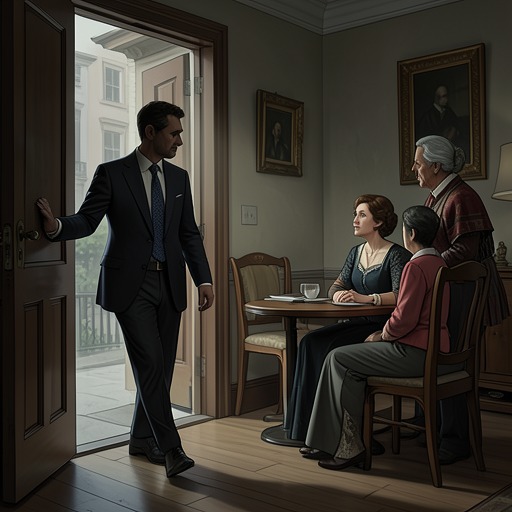
On Wednesday, May 19, 1976, at half past seven, Kemal leaves for the family home. He tells Çetin Efendi only that they are going to return a child’s tricycle to Nesibe the seamstress. Before setting out, he stops at the Merhamet Apartments to collect the tricycle and the pearl earrings his father had given him in a box. The objects mentioned in his earlier letter thus accompany him to the meeting the invitation arranged, connecting the written exchange to the physical act of returning what he had promised.
The note’s importance rests on the difference between invitation and fulfillment. It gives Kemal a welcome, an address, and a date, but it cannot guarantee the marriage he imagines or erase the pain of the preceding 339 days. As he travels through heavy rain, he recalls having longed for this reunion without imagining such a downpour; nevertheless, he feels at peace and believes the waiting has brought him to a happy ending. The letter is the hinge between absence and presence: a small communication that enables the visit, while the hopes Kemal attaches to it reach far beyond anything it actually says.